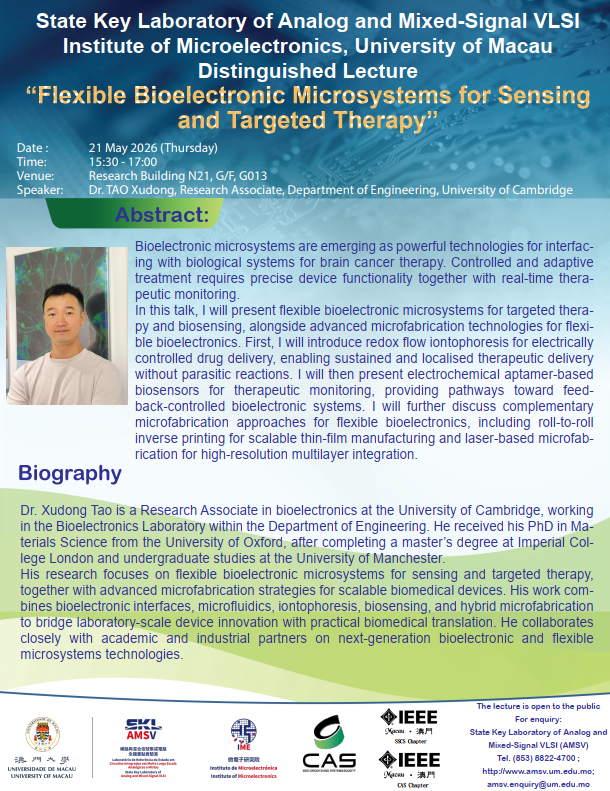
The Distinguished Lecture on “Flexible Bioelectronic Microsystems for Sensing and Targeted Therapy” will take place as follows:
Date: 21 May 2026 (Thursday)
Time: 15:30 – 17:00
Venue: Research Building N21, G/F, G013
The speaker is:
Dr. TAO Xudong, Research Associate, Department of Engineering, University of Cambridge
The Lecture is:
Flexible Bioelectronic Microsystems for Sensing and Targeted Therapy
Abstract:
Bioelectronic microsystems are emerging as powerful technologies for interfacing with biological systems for brain cancer therapy. Controlled and adaptive treatment requires precise device functionality together with real-time therapeutic monitoring.
In this talk, I will present flexible bioelectronic microsystems for targeted therapy and biosensing, alongside advanced microfabrication technologies for flexible bioelectronics. First, I will introduce redox flow iontophoresis for electrically controlled drug delivery, enabling sustained and localised therapeutic delivery without parasitic reactions. I will then present electrochemical aptamer-based biosensors for therapeutic monitoring, providing pathways toward feedback-controlled bioelectronic systems. I will further discuss complementary microfabrication approaches for flexible bioelectronics, including roll-to-roll inverse printing for scalable thin-film manufacturing and laser-based microfabrication for high-resolution multilayer integration.
Biography:
Dr. Xudong Tao is a Research Associate in bioelectronics at the University of Cambridge, working in the Bioelectronics Laboratory within the Department of Engineering. He received his PhD in Materials Science from the University of Oxford, after completing a master’s degree at Imperial College London and undergraduate studies at the University of Manchester.
His research focuses on flexible bioelectronic microsystems for sensing and targeted therapy, together with advanced microfabrication strategies for scalable biomedical devices. His work combines bioelectronic interfaces, microfluidics, iontophoresis, biosensing, and hybrid microfabrication to bridge laboratory-scale device innovation with practical biomedical translation. He collaborates closely with academic and industrial partners on next-generation bioelectronic and flexible microsystems technologies.